
It’s Oppenheimer mania! In coordination with Friday’s( July 21st) release of Christopher Nolan’s Epic Oppenheimer, Turner Book Publishing has released a revised paperback edition of An Atomic Love Story: The Extraordinary Women in Robert Oppenheimer’s Life by Shirley Streshinsky along with historian writer Patricia Klaus. I had the extraordinary honor of talking with Mrs. Streshinsky, in hindsight, about the release of Oppenheimer and the re-release of her book, which is sure to get more attention. Read on!
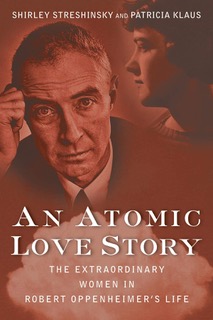
Janis: An Atomic Love Story was originally published in 2013. Tell me the truth: was your book instead that inspired Christopher Nolan to create his Oppenheimer opus? Right?
Shirley: Absolutely. How do I know? Because Nolan is reported to have said that the main biography he consulted was “American Prometheus: The Triumph and Tragedy of J. Robert Oppenheimer” by Kai Bird and Martin J. Sherman, which won a Pulitzer Prize in 2006. I met Marty Sherwin early in our research when I spent the summer in D.C., mostly at the Library of Congress but also in Marty’s home, where he let me—and then Patricia— go through some of his files at his dining room table. When our book was ready for publication, we sent him the final draft and asked for his honest opinion.
He wrote back: “Through diligent research, brilliant insights, and clear, incisive writing, Streshinsky and Klaus have deepened our understanding of Robert Oppenheimer’s emotional life and loves. To comprehend his fascinating complexity, readers interested in the 20th century’s most intriguing American scientist must now supplement the many biographical tomes with this marvelous concise, and precise book. Anyone with the slightest interest in Oppenheimer’s biography will not be able to put it down.” So there you have it! How could Nolan, or anyone having to do with the making of that movie, not have been able to put it down?
Janis: While there are a lot of books about Oppenheimer, you ladies went a different route in writing about him. That is through the eye of the women in his life. What made you go this route?
Shirley: We became convinced that these three women had a story worth telling—his first and lasting woman friend, his first ‘great’ love, and his only wife—and that covering these lives would also fill in the background, revealing what was going on in the country during a period of enormous turbulence: not just in war and science, but in politics with the rise of communism and fascism, and the emergence of psychiatry and psychology. Also, we wanted to get some women into the Oppenheimer dossier; most of the biographies push them to the side; we thought they (we) deserved better.
Janis: Would you say we see the more human side of Oppenheimer in this book?
Shirley: Oh yes. The popular impression of Oppenheimer is of this very suave, handsome, brilliant, rich…figure that both women and men swooned over. In fact, he had a tumultuous adolescence, which included what was probably a nervous breakdown. Jean Tatlock, whom he would always remember as “a lyrical, sensitive, yearning creature,” suffered from deep depressions. Twice, he asked her to marry him, and twice she said no. In the suicide note she left, she wrote, “To all those who loved me and helped me, all love and courage. I think I would have been a liability all my life. I wanted to live and to give, and I got paralyzed somehow.” Oppenheimer was at Los Alamos when he got the message, and it is reported that he wept.
Janis: Many rave at how well-researched the book is. Was the research difficult? How did you two both go about it and bring it all together?
Shirley: Having written a biography of John Audubon, I understood how difficult the research was going to be in this more modern book. My historian friend Patricia had the perfect background and agreed to sign on. Was it difficult? Probably, but mainly it was just great fun. Patricia knows how to dig deep and turn up all kinds of new information. We both live in the Bay area, about 40 miles apart. We met regularly at a brewpub in between, and of course, the phone lines lit up. Patricia would call and say something like, “Guess who I am going to have lunch with in New York next week?” And it would be Jean Tatlock’s nephew. Or one of Ruth Tolman’s best friends, well into his 80s, who also knew “Oppy” and Kitty and most of the other main characters. Another day she discovered the name of Kitty’s first husband; Kitty had the marriage annulled; the man remarried, and we found his daughters—lovely women. Patricia was also able to discredit Kitty’s claim of any kind of “royal connections” by finding her great-nephew, who wrote that Kitty was “storytelling” about any connection to the Belgium King or any other European kingdoms.
My physicist neighbor introduced me to physicist Ed Lofgren, who had been at Los Alamos with Oppenheimer and was then in a senior facility in Oakland. Over several weeks’ worth of lunches, he answered all my questions. Ed had a booming voice, and one day we were in a small coffee shop, and he was holding forth on some subject; then, when I asked for the check, the waitress told me it had already been paid, with a thank you from another customer.
Janis: While Oppenheimer seems to be the draw of the book, is it true this book also had a bit of deeper meaning? For example, showing what life was like for the growing independence of the American woman at the time of the early 20th century.
Shirley: Yes. Yes. Oh yes. Certainly, the three women we chose who were at the core of Oppenheimer’s life—as well as his mother—lived privileged lives. His mother was an accomplished artist (who married an immigrant who became rich, which accounts for the family’s great art collection). And by tracing the “bloodlines” of Ruth Tolman and Jean Tatlock, we get a quick lesson about where they fit into the history of the country. Kitty, of course, had her own German history—a cousin was a top aide to Hitler.
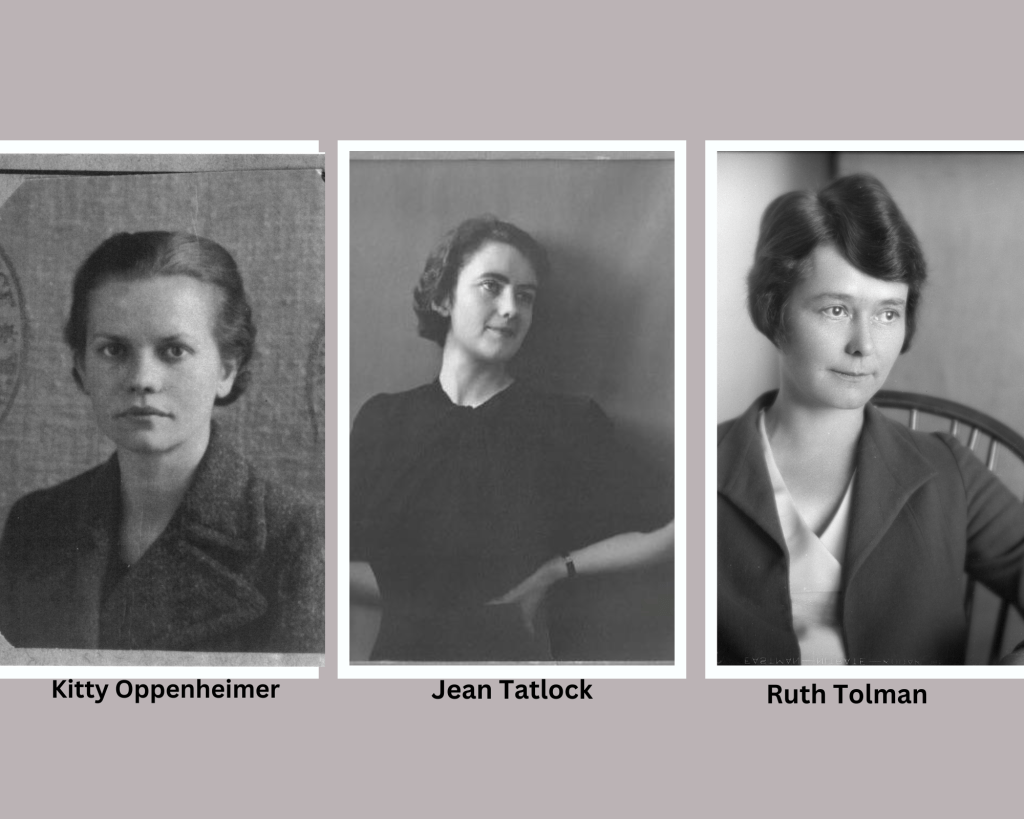
Ruth had a Ph.D. and worked in responsible positions; Jean was a medical doctor and a psychiatrist; Kitty wanted desperately to finish a Ph.D. in botany but became so entangled in the men in her life (three husbands until she settled on JRO) that she never got around to it. In some ways, these four women (counting his mother) offer a sharp look at what it was like —even for women who had the means— in that roiling first part half of the 20th century. Most of the JRO biographies are about men; the women make an appearance. There was a much-ballyhooed program on television the other night about Oppenheimer. A few women made cursory appearances; mostly, there were men standing or sitting in front of huge period photographs. The one that, for some reason, sticks in memory is a screen-sized photograph of an empty bathtub filled with water. Probably referring to the fact that Jean drowned herself in her bathtub when she was 29. We get that this atom-bomb making was mostly done by men, but there were women in these men’s lives, taking part in all that was going on in a time of great struggle. Women at Los Alamos, women in war plants, women doing their share, and more. And yet even now, in 2023, the history books and the biographies are still mostly about the men.
The main thing we want to say about our book is that it is not a romance, in spite of the title. It is a biography of Robert Oppenheimer. And a record of the time. We get into all the bomb-making and the war and how smart all those scientists were to push it through to the grand finales over Hiroshima and Nagasaki. The men who proved it could be done; that Nature was not allowed to keep it secret; that it was possible to set the whole world ablaze, and how no one would survive a nuclear holocaust. Leaving J Robert Oppenheimer to represent all of those super-smart men who figured it out. We needed the women who were part of it all to come in from the background as well.
A huge thank you to Mrs. Streshinsky and her publicist for this opportunity to chat! Remember An Atomic Love Story: The Extraordinary Women in Oppenheimer’s Life is out and available via AMAZON or wherever books are sold.

The interview was also featured in INTERVIEW on vocalmedia.com
 Freelance Writer Janny(Jan Marie)C